
A Galaxy A54 5G can reach the blue or teal Download Mode screen and still stay blank inside Odin on a Windows repair PC. The owner may have installed Samsung USB drivers, changed cables twice, and tried every button combination. Odin still shows no COM port. That is a different fault from a phone that cannot enter Download Mode at all, so treat it as a USB detection and mode handshake problem first.
This guide is for owner authorized work on the Galaxy A54 family, including common SM-A546B, SM-A546E, SM-A546U, SM-A546U1, and SM-A546W variants. The checks also fit nearby A series models, but firmware decisions must stay exact to the model and region. Do not use this path to bypass account locks, alter identifiers, or flash a package that does not belong to the phone.
Confirm the A54 is really in Download Mode
The first bench check is simple. Odin can only detect the A54 for firmware work when the phone is in Samsung Download Mode, sometimes called Odin Mode. A normal powered on phone may appear in Windows for file transfer, and ADB may see it after USB debugging is allowed, but that does not prove Odin will see it.
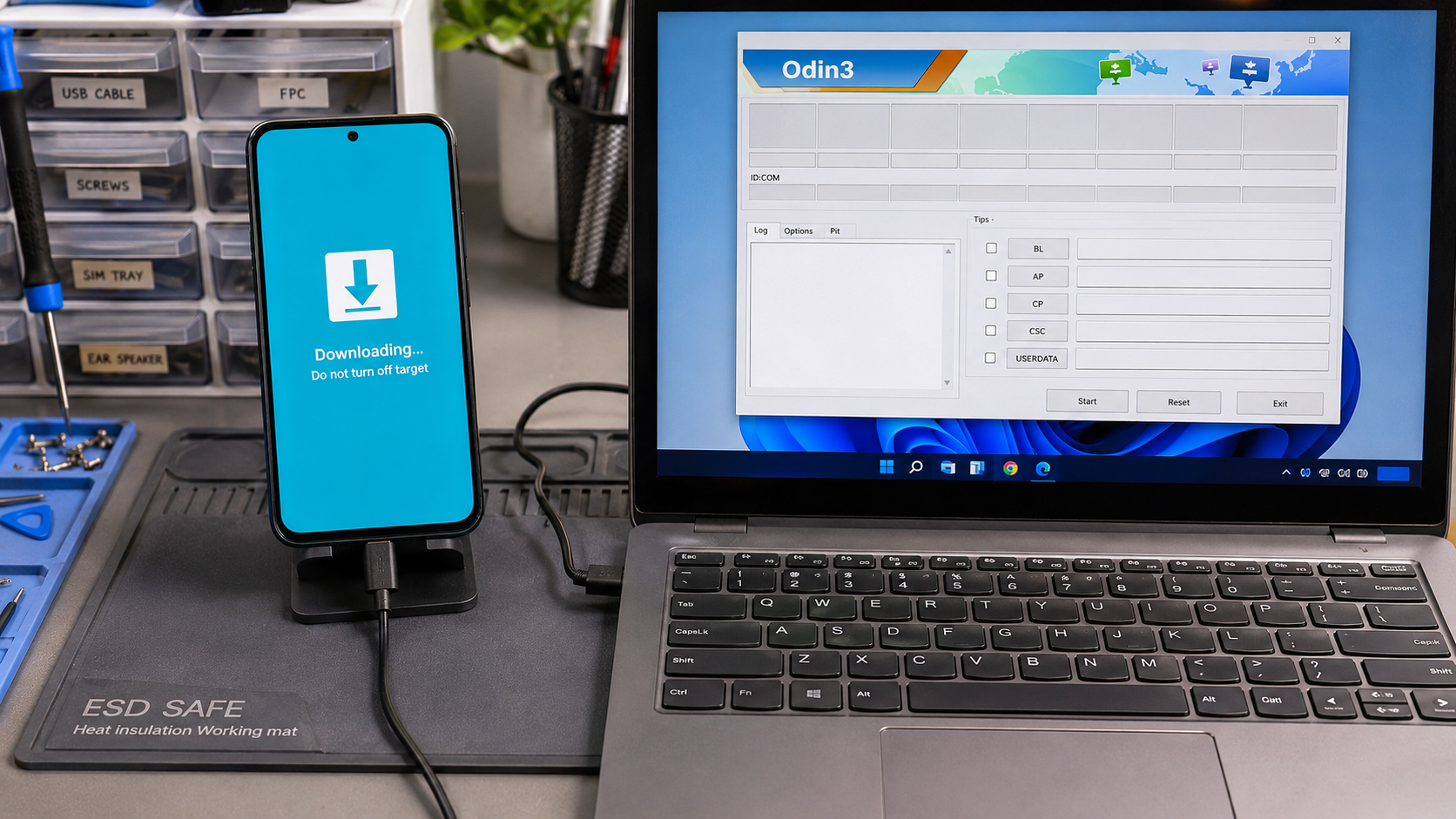
Power the Galaxy A54 off. Connect a known good USB data cable to the Windows PC. Hold Volume Up and Volume Down together, then connect the cable to the phone if it is not already connected. On many A54 builds this opens the warning screen. Press Volume Up once to continue into Download Mode. The phone should show a download screen and a warning not to turn off the target.
If the phone only boots Android, charge it for at least twenty minutes, remove the case, check that neither volume key is stuck, and try again with the cable connected to the PC. If the A54 cannot enter Download Mode with working keys, the problem may be button hardware, USB port behavior, battery state, or damaged firmware. Stop before selling a driver reinstall as the fix.
Separate Odin detection from Android file transfer
Windows can see a Galaxy A54 in several different ways. In normal Android, it may appear as an MTP device for photos and files. In ADB, it may appear only after USB debugging is enabled and the owner accepts the computer. In Download Mode, it should appear through the Samsung USB driver stack as a flashing interface that Odin can bind to.
That distinction matters after a driver install. A phone that appears in File Explorer after boot but not in Odin is often using the wrong mode, a charge only cable, a bad USB port, or a Windows driver binding problem. A phone that appears nowhere, even in Device Manager, points more toward cable, port, power, or the phone USB connector.
On Windows 10 or Windows 11, open Device Manager before launching Odin. Connect the A54 in Download Mode and watch for a new entry. It may appear under USB controllers, modems, portable devices, or other devices depending on the driver state. If Device Manager refreshes when the cable is plugged in, the PC is at least seeing a USB event. If nothing changes, stay with hardware checks before changing software.
Use a plain cable and a direct USB port
The A54 uses USB C, and many USB C cables charge well while failing data. Start with a short data capable cable. Connect directly to a rear motherboard USB port on a desktop or a built in port on a laptop. Avoid hubs, monitor ports, docks, front panel extensions, loose USB C adapters, and long multi use cables during the first test.
If Odin stays blank, change one thing at a time. Try another cable, then another PC port, then another Windows machine if one is available. Do not keep reinstalling drivers after every attempt. Repeating the same driver package can hide the real fault and waste the owner timeout when the issue is a cable that never carries data.
- If the phone charges but Windows makes no connection sound, suspect cable, port, debris, or board level USB damage.
- If Windows connects and disconnects repeatedly, test a shorter cable and inspect the A54 USB C port for lint, liquid marks, or movement.
- If Device Manager shows an unknown device, remove that failed entry, reconnect in Download Mode, and let Windows bind the Samsung driver again.
- If Odin sees the phone on one PC but not another, the phone is not the first suspect. Fix the workstation.
Clean up the Samsung USB driver path
A fresh Samsung USB driver install should be done with the phone disconnected. Close Odin, Smart Switch, Kies if it is still present, Android platform tools windows, and any phone management software. Install the current Samsung USB driver package from a trusted Samsung repair or support path, restart Windows, then connect the A54 in Download Mode again.
On a repair bench, I prefer one clean driver stack over three overlapping phone suites. Old Kies remnants, generic Android composite drivers, and phone transfer utilities can grab the wrong interface. If Device Manager shows the A54 under a warning icon, uninstall that device entry and choose the option to remove the driver only when you are sure it is the bad binding. Then reconnect the phone in Download Mode.
Odin should show a filled ID COM box when the driver and mode handshake are correct. The exact COM number does not matter. If the box lights up, do not change drivers again. Move on to firmware package checks, backup decisions, and model matching. If it does not light up, keep diagnosing the connection instead of loading a firmware file and hoping the flash button wakes the port.
Check Odin version and the Windows session
Use a known, clean Odin build that matches current Samsung devices. Very old Odin builds can behave badly with newer A series phones, and modified tools add risk you cannot explain to the owner. Run Odin after the phone is already in Download Mode, and avoid running it from inside a synced cloud folder or a path with restricted permissions.
Windows security prompts, driver signature state, and corporate endpoint tools can also block a repair session. If this is a work laptop with device control software, test on a simpler machine before blaming the A54. If the phone is detected in Device Manager but Odin still shows nothing, close Odin, reconnect the phone, and reopen Odin as an administrator. That is a workstation check, not a permission to flash the wrong file.
Do not open several flashing tools at the same time. Smart Switch emergency recovery, Android tools, and Odin can compete for the same USB interface. Keep the session boring. One phone, one cable, one direct USB port, one Odin window.
Know when ADB helps and when it cannot
ADB can be useful only when Android boots far enough for USB debugging to be enabled and authorized. If the owner can unlock the phone and has already allowed the PC, the command adb reboot download can send some Samsung phones into Download Mode without fighting button timing. That can help when a volume key is weak but Android still works.
ADB cannot make Odin detect a phone that is already sitting in Download Mode with a bad cable or broken driver binding. It also cannot help when the phone is locked, untrusted, or unable to boot Android. Do not ask the owner to enable USB debugging after the phone is stuck at a warning screen. That setting lives inside Android, not inside Download Mode.
If ADB works and the phone reboots into Download Mode, return to the Odin ID COM check. If Odin still stays blank, the original fault remains in the Download Mode USB path. If ADB does not list the device while Android is running, that may be normal when debugging was never enabled, so do not mistake it for proof of a firmware fault.
Match the firmware before any flash attempt
Driver detection is only the entry ticket. Before any firmware repair, identify the exact A54 model, current region or carrier code, Android version, One UI version, binary revision, and the owner data risk. A Galaxy A54 sold as SM-A546B for one region is not the same repair target as an SM-A546U carrier unit. Packages can look close and still be wrong.
If the phone still boots Android, back up photos, chat exports, authenticator recovery codes, banking app requirements, Secure Folder content, and work profile data before touching Odin. If the phone does not boot, explain the data risk before proceeding. A clean flash with the wrong CSC choice can wipe user data. A mismatched package can fail or leave the device in a worse boot state.
For an OTA related case, ask what happened before Download Mode was needed. A failed monthly patch, a One UI upgrade, a boot loop after update, and a phone that was dropped during repair are different jobs. Odin detection does not decide the repair by itself. It only tells you the PC can talk to the phone in the right mode.
Use this bench decision path
- If the A54 is not on the Download Mode screen, enter Download Mode first and do not judge Odin while Android is running.
- If Download Mode appears but Windows shows no USB event, test cable, direct port, phone connector, and battery state.
- If Windows shows an unknown or warning device, clean the failed binding, reinstall the Samsung USB driver with the phone disconnected, restart, and reconnect in Download Mode.
- If Device Manager sees the phone but Odin stays blank, close competing phone tools, try administrator launch, and test a clean Windows 10 or Windows 11 machine.
- If Odin finally shows ID COM, stop changing drivers and verify exact SM-A546 model, region, binary revision, and backup status before any firmware work.
- If the phone cannot enter Download Mode and ADB reboot download is unavailable, suspect button, USB, battery, or board level damage and escalate.
- If the owner cannot prove authorization or cannot pass account verification after a reset, stop. This is not a software driver problem.
What not to touch on this symptom
Do not wipe data because Odin is blank. A factory reset inside Recovery mode will not repair a Windows driver binding, and it can turn an owner complaint into a data loss case. Do not press random Odin options to see what happens. Re partition, NAND erase, PIT files, and model mismatched firmware belong outside a normal A54 detection repair.
Do not scrape firmware from a random page because the file name includes A54. Match the exact model and region through a trusted repair process, and check the binary revision before flashing. If the A54 is under warranty, has liquid damage signs, has a loose USB C port, or disconnects on multiple known good cables, use authorized support or hardware diagnosis before firmware work.
The clean repair order is narrow. Put the Galaxy A54 in Download Mode, prove the USB data path, clean the Samsung driver binding, test Odin on a quiet Windows session, then decide whether firmware repair is actually needed. When the ID COM box appears, the detection problem is solved. The next decision is backup, model match, and whether flashing is safer than stopping.